The Gaia asteroid spectra collection is an excerpt from the Gaia DR3 catalogue, providing the largest collection of asteroids spectra to date, with 60,518 different objects. This data service provides simple and easy access to measured asteroid spectra and powerful search functions from the VESPA portal, including cross-matches with other services of similar content.
Virtual Observatory service
The Gaia space observatory has performed accurate measurements of many celestial objects, including some in the Solar System. The complete DR3 (Data Release 3) data is distributed at ESA and is accessible in the Virtual Observatory though the TAP protocol. The current Gaia asteroid spectra service has been set up to provide smoother access to these spectra in a Solar System-friendly environment, and to allow cross-matching with similar services of different origin. The spectra are extracted from the ESA tables with no additional processing. They cover the optical range from 0.374 to 1.034 µm in 16 channels. Spectra are averages of several measurements, calibrated in reflectance (I/F) and normalized at 0.55 µm (see bibliographic references).
The collection is presented in a table with descriptive parameters for each spectrum:
– Each row links to a single spectrum
– Thumbnails have been produced to provide a quick visual diagnostic in the search interface
Spectra are available individually in VOtable format. This format is self-described and can be handled by VO tools. Spectra include wavelength, reflectance, uncertainty, and quality flags.
The service table is formatted according to the EPN-TAP standard, which implies that column names and units are standardized. The data service can be queried using the TAP protocol, in particular from the VESPA portal of Solar System data: https://vespa.obspm.fr/
See the complete data service in the VESPA portal (the schema name is gaia_asteroids).
A tutorial for spectral studies in the Planetary Science VO context is available here:
http://voparis-europlanet.obspm.fr/utilities/Tuto_Spectro_VESPA.pdf
In particular with the CASSIS tool:
http://voparis-europlanet.obspm.fr/utilities/Tuto_CASSIS_VESPA.pdf
In short: you first identify data of interest from a search interface, then send selected results in a visualization and analysis tool. The plotting tools of choice for spectra are CASSIS and SPLAT-VO, which can handle conversions of the spectral axis (TOPCAT may also be convenient).
Looking for spectra
Searches based on decriptive parameters can be performed from the VESPA portal or any TAP interface (TAPhandle, TOPCAT, etc). A specific EPN-TAP client is also installed in the CASSIS spectral tool.
Query results are tables, with a row describing each match. The column access_url provides a link to the spectrum.
Important search parameters include:
target_name – name of the object, either the standard IAU name or the principal designation
alt_target_name – other designations – the quaero name resolver (available from the VESPA portal) can disentangle various designations
spectral_range_min / spectral_range_max – limits of the spectral range (given in Hz in the table, convertible to µm in the VESPA portal)
spectral_resolution_min / spectral_resolution_max – estimate of (delta lambda) / lambda.
measurement_type – always reflectance, encoded as a UCD
data_calibration_desc – contains short information as a free format comment
access_format – always indicates VOtable format (as Mime type)
granule_gid – constant (not used)
granule_uid – a unique identifier from the original Gaia service at ESA
thumbnail_url – a thumbnail used in the VESPA portal, especially in gallery mode
time_min / time_max – these values identify the period when observations were performed. However the published spectra are usually averaged from many observations and these parameters do not indicate a specific configuration (Earth distance or phase).
Alternative access
A secondary table is published in this service, which includes spectra each on a single row (wvl, reflectance, error, and flags are stored as arrays on separate cells). Although intended for internal use, this table may be queried to retrieve directly many spectra, e.g. for plotting in TOPCAT using the array pair plot control in the Plane plot window. This table is a simple reformatting of the original Gaia table and is not EPNCore compliant:
SELECT TOP 1000 * FROM gaia_asteroids.gaia_source
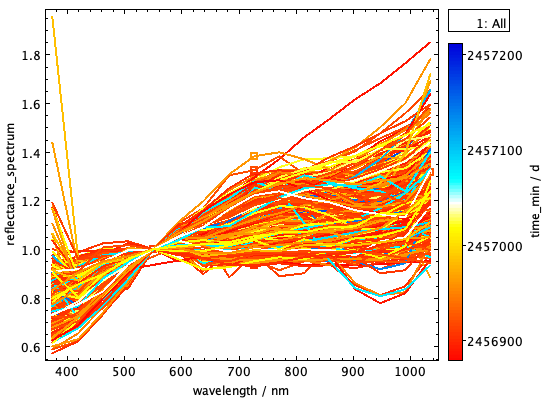
The original Gaia service provides the asteroid spectra in a different form. They are distributed in a single table and can be accessed using a generic TAP client (e. g., TOPCAT) on ESA server (https://gea.esac.esa.int/tap-server/tap). To retrieve the spectrum of Metis, type:
select * from gaiadr3.sso_reflectance_spectrum where denomination LIKE '%metis%'
this returns 16 rows with individual channel measurements.
Additional spectra of asteroids and dwarf planets are available in other EPN-TAP data services, e. g., spectro_asteroids, M4ast, spectro_trojans, spectro_m_ast, or HST_planeto. They can be queried simultaneously from the VESPA portal.
Support
Contact the helpdesk for comments: support.vespa@obspm.fr
_____________________
This data service is provided in the framework of the CNES/INSU Small Body Data and Service Center, reusing the VESPA infrastructure developed in Europlanet-2024-RI with support from Paris Astronomical Data Centre (PADC).



The Europlanet 2024 Research Infrastructure project has received funding from the European Union’s Horizon 2020 research and innovation programme under grant agreement No 871149. Additional funding was provided by the Action Spécifique Observatoire Virtuel and Programme National de Planétologie / INSU.