

Students and colleagues
As a professor, researcher, and head of a laboratory or team, I have shared with many students the enthusiasm and anxieties of research, the joys of discovery and success. I have sometimes guided them in their early careers. I mention below most of those with whom I was closest—doctoral and postdoctoral students—and to whom I owe so much!
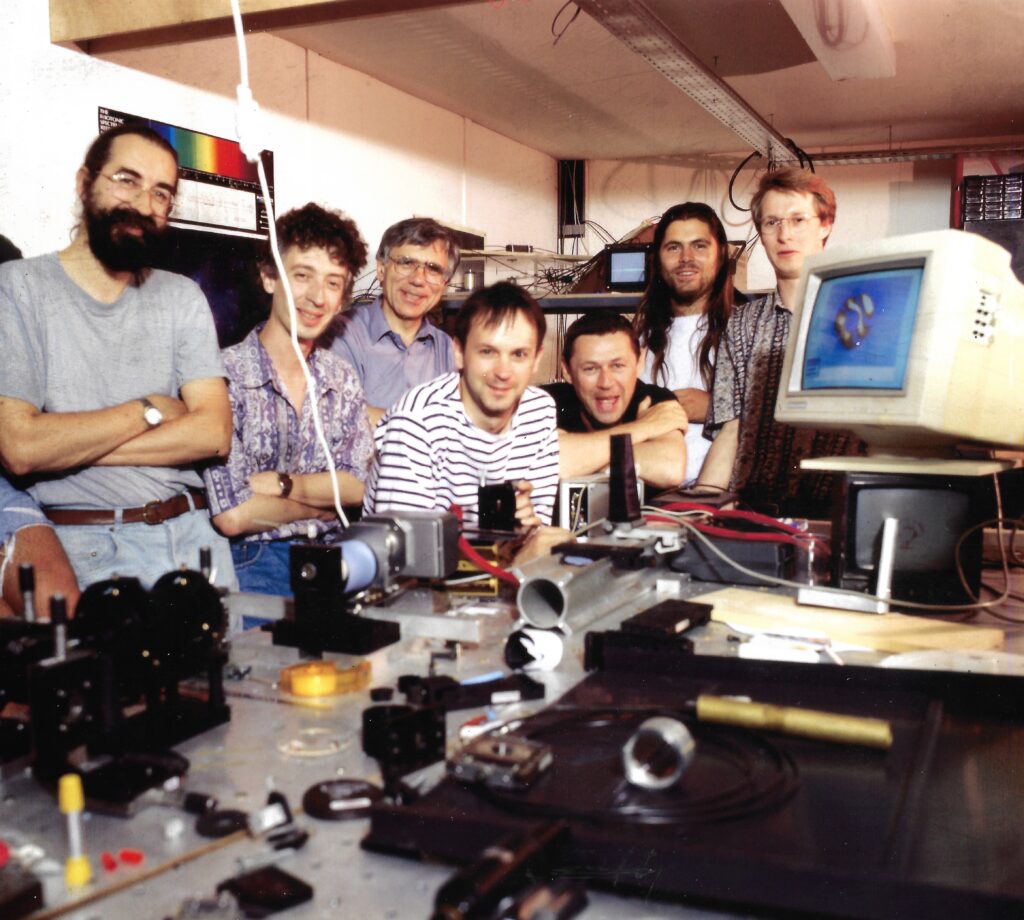
Photo at left. At the Paris Observatory (DESPA), in 1995, from left to right: Jean-Marie Mariotti (+1998), François Lacombe, PL, Olivier Marco, Daniel Rouan, Olivier Lai, Guy Perrin
PhD students (direction or close collaboration)
See the full list and PhD subjects on the page in French.
Main domains of activity and contributions
Diffraction-limited images and Adaptive optics (since 1979)
In 1970, Antoine Labeyrie demonstrated that it was possible to overcome the resolution limits imposed by atmospheric turbulence on astronomical images obtained with a large telescope (speckle interferometry). After 1976, we adapted this method to the infrared range using the large telescopes at Kitt Peak (4m, Arizona) and La Silla (3.6m, Chile), reaching their diffraction limit. This paved the way for the emergence, starting in 1982, of adaptive optics, without which multi-telescope interferometry cannot fulfill its potential. Working closely with ESO and ONERA in France, the world’s first demonstration of astronomical image correction using adaptive optics was given in 1989, followed by many scientific results. The path was opened, and it continues to be refined; by 2026, giant telescopes worldwide will be equipped with it. The resolution of astronomical images can reach a few ten-millionths of an arcsecond, a fantastic improvement over the one arcsecond limit imposed by the atmosphere until the 1970s.
Optical interferometry with multiple telescopes (since 1980s)
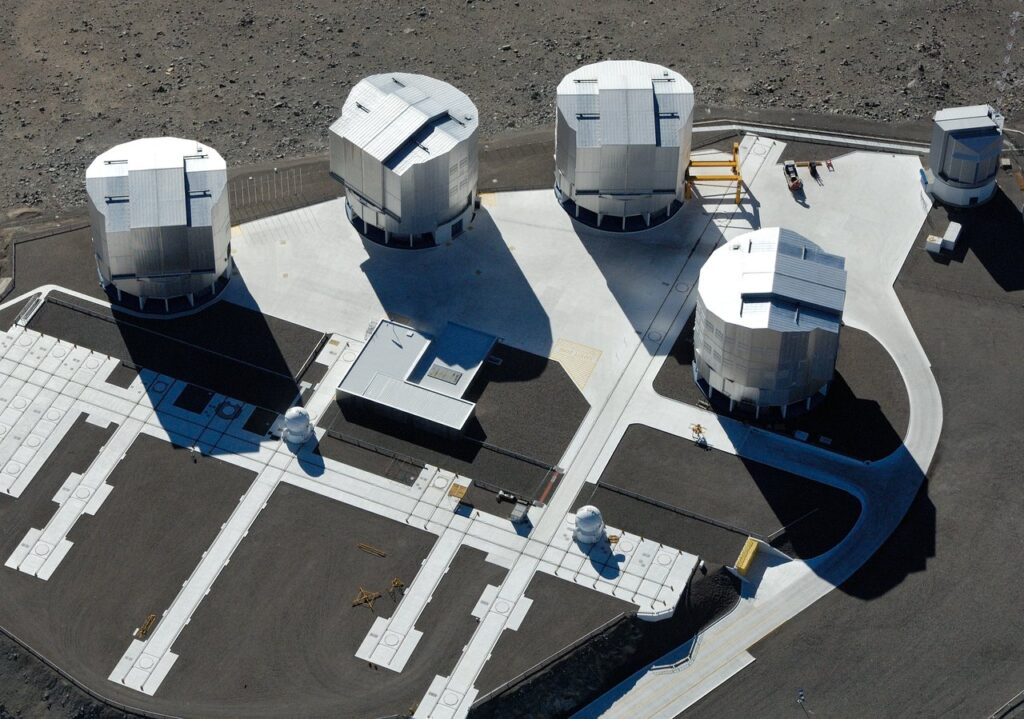
As early as 1979, the European Southern Observatory’s planned for a new telescope. Optical interferometry, demonstrated in 1975 by Antoine Labeyrie, could be considered. It would offer the prospect of images with details reaching a thousandth of an arcsecond. The design, up until 1982, then the construction of the Very Large Telescope Interferometer (VLTI) and its instruments culminated in success in 2002, with the involvement, at ESOs side, of French teams in Meudon and Grenoble.
The infrared sky (1972-1980)
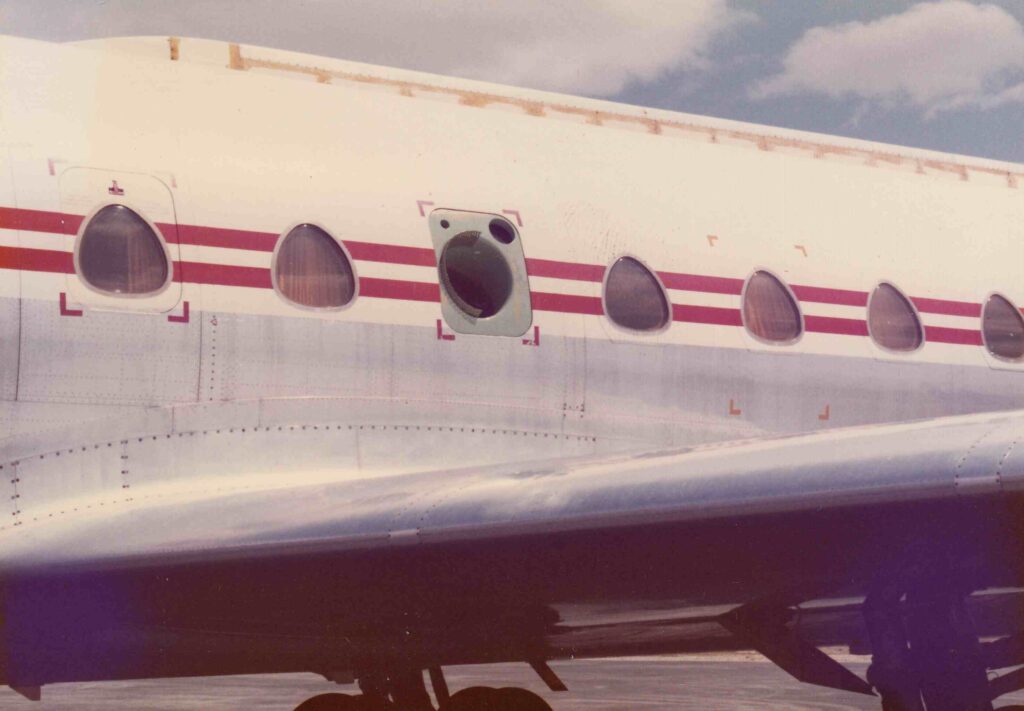
The promises of infrared for studying star formation was so great that an airborne observatory was planned in France. The Caravelle 116 aircraft from the Centre d’Essais en Vol was equipped with a small telescope, which we also installed on NASA’s CV-990 quadjet. Molecular clouds, dust, and the center of our Galaxy, as well as the active galaxy NGC 1068, were successfully observed until the first infrared satellite (NASA’s IRAS) rendered our instrument obsolete. After 1984, the European Infrared Space Observatory (ISO) program occupied our DESPA laboratory at the Paris Observatory until its launch in 1995, yielding considerable results.
The infrared Sun (after 1962)
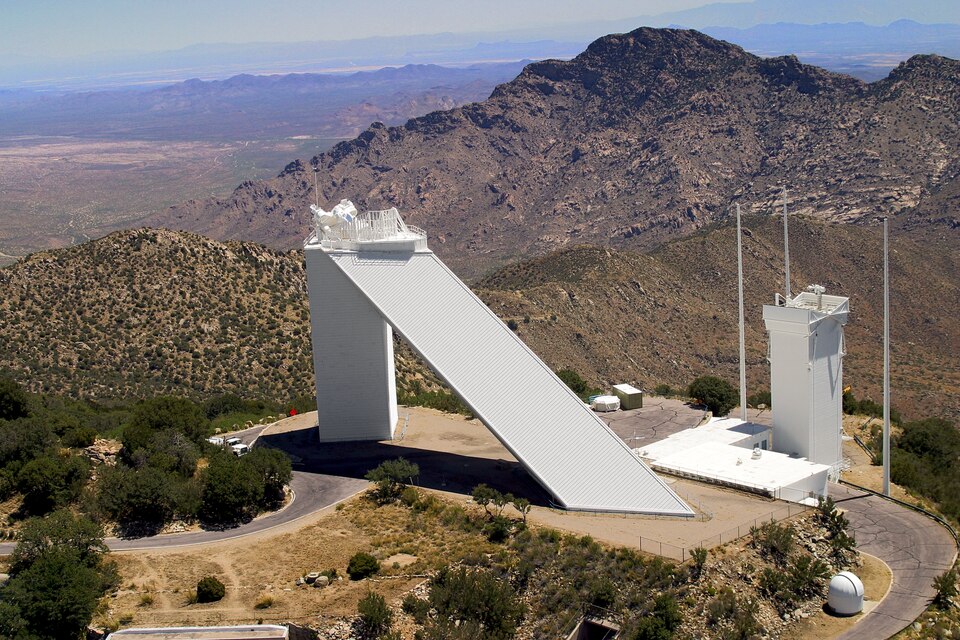
From 1958 onward, the nascent access to space opened new perspectives for astrophysics in the ultraviolet and infrared ranges. Observing the Sun in the infrared would clarify the temperature regime of the photosphere-corona transition. My high-altitude observations, first from the Kitt Peak Solar Observatory (Arizona), then from a NASA aircraft with the High Altitude Observatory (Colorado), contributed to this field, employing new techniques in this unexplored range of wavelengths (from 2 to 300 micrometers): detectors cooled to 4 Kelvin and Fourier transform spectrometry. The total solar eclipse of 1973, observed aboard the supersonic Concorde 001, marks the end of this first chapter for me.