

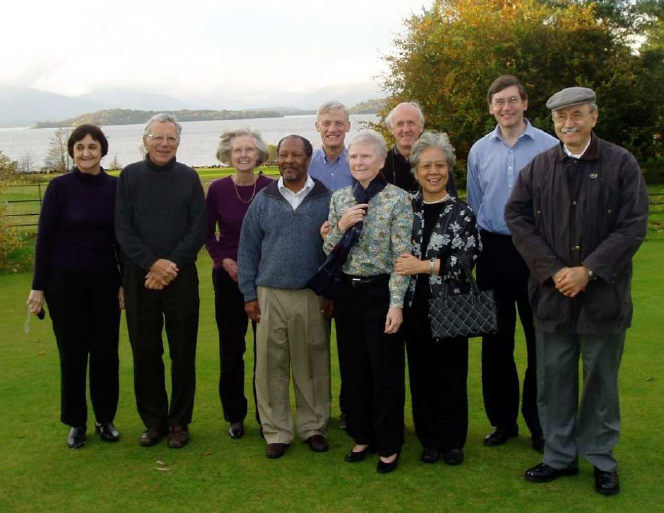
In 2005 in France, the Académie des sciences, jointly with the École des Mines de Saint-Etienne, established a yearly international Prize, named Purkwa, “for the scientific literacy of the children of the planet”. The Prize was split half-and-half, awarded to two educators, one from the South, one from the North. In 2008, the winners were Guillermo Fernandez de la Garza (Mexico) and Dame Wynne Harlen (UK). Wynne devoted the Prize money to call in 2009 a dedicated Seminar , inviting for a week some actors engaged in science education for primary schools, near her home in Scotland, on the beautiful shores of Loch Lomond .
At the Seminar (from left to right) Rosa Deves (Chile), Pierre Léna (France), Wynne Harlen (UK), Hubert Dyasi (United States), Derek Bell (UK), Patricia Rowell (United States), Robin Millar (UK), Wei Yu (China), Derek Bell (UK), Guillermo Fernandez de la Garza (Mexico) discussed and wrote this book, developing the concept of a limited number of “big ideas” in science and of science, to form the core of a curriculum in primary and middle school.
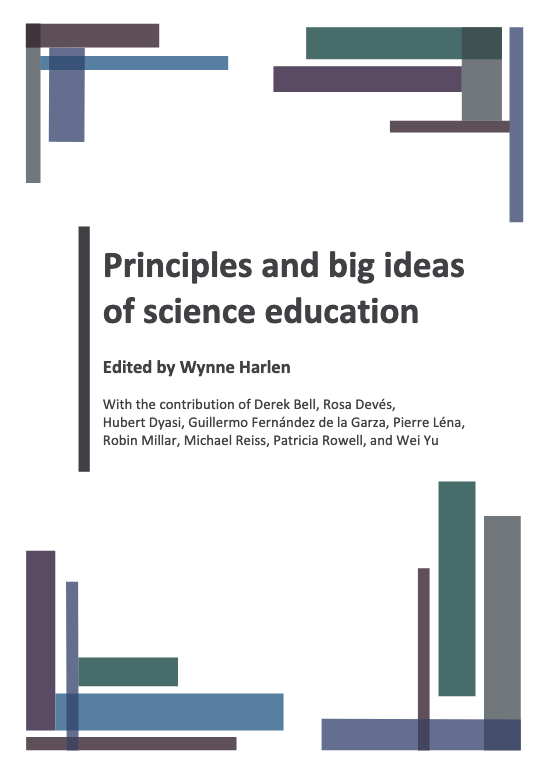
Below are presented the (9+4) Big Ideas which are discussed in the first book Principles and Big ideas of science education, Wynne Harlen (2010), as published following the 2009 Loch Lomond Seminar. It is made available by InterAcademy Partnership, thanks to the Association for Science Education (UK). The second book Working withh Big Ideas of Science Education, Wynne Harlen (2015), elaborating on the first one, is also available on line, as well as its translations in 8 languages.
Ideas of science
- All material in the Universe is made of very small particles.
- Objects can affect other objects at a distance.
- Changing the movement of an object requires a net force to be acting on it.
- The total amount of energy in the Universe is always the same but energy can be
transformed when things change or are made to happen. - The composition of the Earth and its atmosphere and the processes occurring
within them shape the Earth’s surface and its climate. - The solar system is a very small part of one of millions of galaxies in the Universe.
- Organisms are organised on a cellular basis.
- Organisms require a supply of energy and materials for which they are often
dependent on or in competition with other organisms. - Genetic information is passed down from one generation of organisms to another.
The diversity of organisms, living and extinct, is the result of evolution.
Ideas about science
- Science assumes that for every effect there is one or more causes.
- Scientific explanations, theories and models are those that best fit the facts known
at a particular time. - The knowledge produced by science is used in some technologies to create
products to serve human ends. - Applications of science often have ethical, social, economic and political
implications.