Nancy Grace Roman Space Telescope is NASA’s next astrophysics flagship mission. With a size (2.4m), sensitivity and resolution comparable to Hubble, but a field of view 100 times higher (i.e. bigger than the apparent size of the full moon!), Roman is designed for a suite of general astrophysics survey, including dark energy and dark matter focus.
NASA Nancy Grace Roman Space Telescope will be launched on August 30, 2026
Roman will onboard two instruments: the Wide Field Imager and the Coronagraph Instrument technology demonstration. Its primary instrument (the Wide Field Imager) will map how matter is distributed throughout the Universe, capturing essential information spanning from dark energy to dark matter along with new exoplanet discoveries and extreme objects like supermassive black holes and distant quasars.
The coronagraph instrument
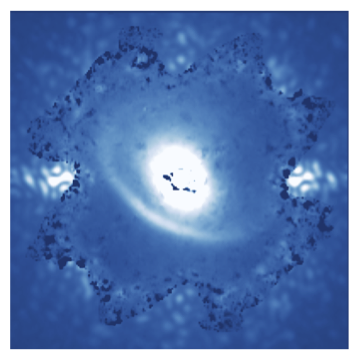
On the opposite side of the field of view range, the Coronagraph Instrument aims to image planets and disks around nearby stars with performance two or three order of magnitude better than any other coronagraph ever flown on previous space missions (Hubble, JWST). To achieve such prowess, two deformable mirrors can be reshaped in real time to compensate for microscopic telescope optical defects. Jupiter-like planets could be directly observed for the first time with this instrument.
The Coronagraph Instrument attenuate starlight to unveil faint distant worlds
French participation to the coronagraph instrument
The Centre National d’Etudes Spatiales (CNES) was contacted by NASA to contribute, through a partnership with LAM (Laboratoire d’Astrophysique de Marseille), and provide the coronagraph super polished static mirrors. It offered French institutes a participation to the instrument science program. French researchers are then planning the first observations with the telescope and will analyze the first data coming from the coronagraph instrument among the international collaboration led by NASA.